Zahra Glenda Baker: We Will Care For Each Other
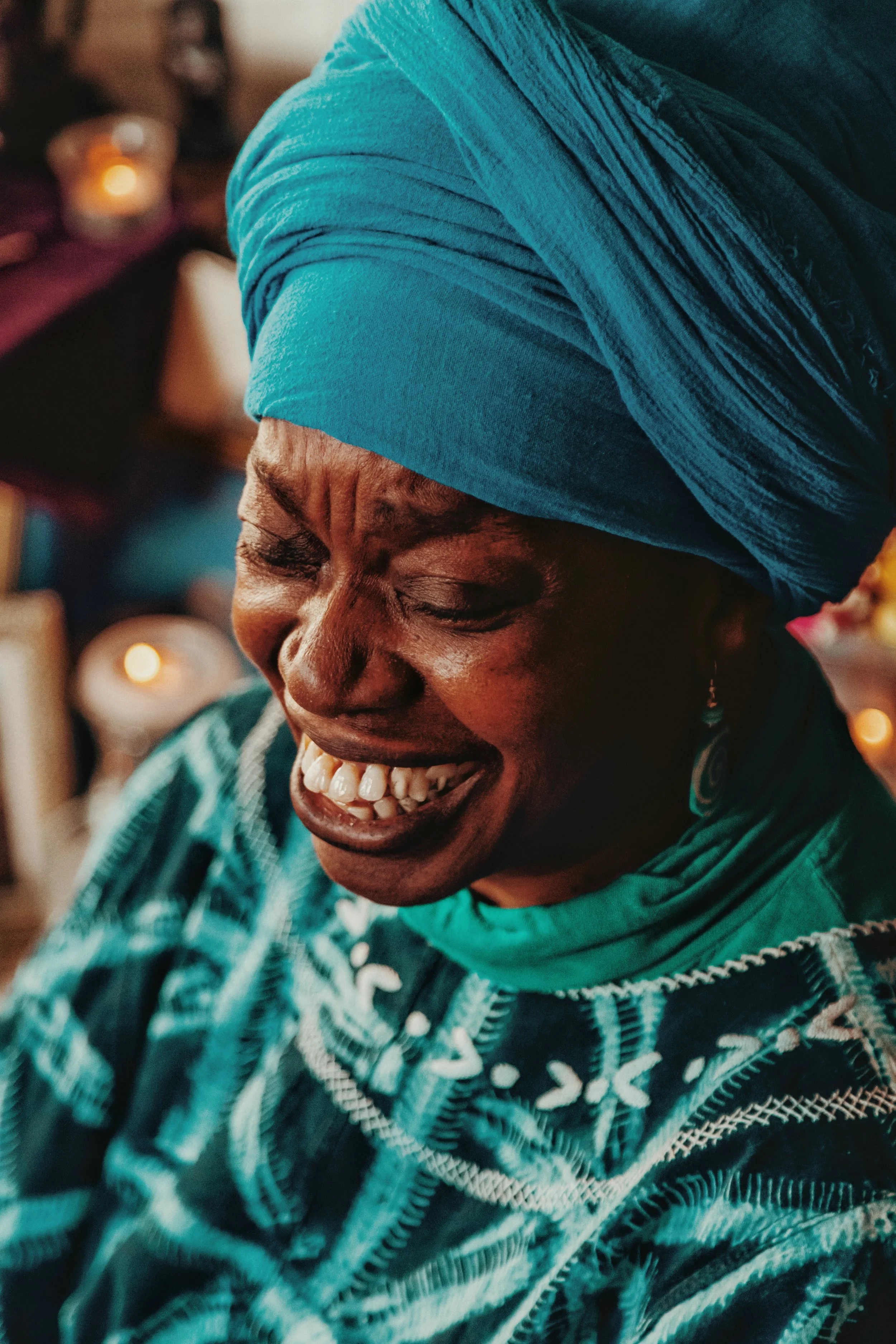
Photograph by: Loren Toney
In a time of cultural erasure, What Time Is It? A Cultural & Civic Archive serves as a praxis of cultural preservation and activism. This week, we're sharing the powerful words of Zahra Glenda Baker, a legendary storyteller, vocalist, performer, and teaching artist.
Irina: It's such an honor to be in your home. Thank you so much for having us. I've really dreamt of getting to know you better, and when we talked about having you be part of the archive, it's really a true honor, so thank you so much for your willingness to share your stories with us today.
Zahra: It's my honor. Thank you.
Irina: So we usually just start with a little check-in question just to ground us in a space. Maybe we could all just take a breath together and just feel our bodies connecting to the ground, to the air, the fire, the water, the land, and any spirits or ancestors we want to invite into this space with us today.
Zahra: My Great Grandmother to Fairella Mills.
Irina: My Babushka Luba.
Loren: My grandma Emma.
Irina: Zahra, you started sharing a little bit about your art practice over the last year, and I’m curious: as a storyteller, what are some of the stories that feel very alive in you right now? Stories you want to make sure are told and archived for the future.
Zahra: Yeah. One creative project that keeps coming up is about Callie Guy House, who was a front-runner in the fight for reparations for formerly enslaved people, during a time when many of them were still alive. She was able to take the case all the way to the Supreme Court by going around, gathering their stories, sitting with them, listening, and learning what life had been like post-slavery. What stands out most to me is the abuse that continued, and the neglect in meeting their needs in so many ways. She felt it was important that they be taken care of. Another part of her work was believing that while we waited for the government to take responsibility, the community needed to stay together by caring for each other.
She co-founded a mutual aid and relief fund that engaged over 300,000 people throughout the South. What’s exciting for me is that I had known her story, but I wasn’t sure—as a storyteller and performer—how to tell it in the best way. Over the last few years, it’s evolved through my personal work building relationships with my ancestors, especially my great-grandmother, who I was named after. Through meditation and journaling with her, I discovered that she and her husband - my great-grandfather, who was a minister - would host Callie when she came down to central Louisiana. That made sense, because Callie was making her connections through Primitive Baptist churches, and my great-grandfather was a minister connected to many tent meetings and community networks. It makes sense that this is how Callie connected across the South… through ministers.
The only thing I had ever known about my great-grandmother was that people called her “the First Lady,” the minister’s wife. Her role in community was always at the forefront. Hearing her tell me how much she looked forward to Callie’s visits two or three times a year was powerful. Callie would bring news about what was happening around the country, because she was always traveling. It helped them feel connected beyond central Louisiana and connected to a larger purpose. That excites me because most Black History Month stories focus on famous people who did great things. But we wouldn’t be here without so many unnamed people. It made me proud that my great-grandparents were committed to social justice, doing what they could in their small town.
I’ve developed a performance based on their meeting called Sacred Encounters. Their relationship was beautiful and powerful. Whenever they came together, both of them were activated. I’ve blended that story with my musical sensibility as a creative improvisational musician, pulling from the spiritual energy of the Primitive Baptist Church I was raised in. I don’t practice Christianity anymore, but those songs and energies are bigger than religion. The biggest message of the piece is in the closing song, which says, “We will care for each other for the rest of our lives.” That’s what Callie wanted. That’s what my grandparents wanted. That’s what I want. That’s what I need. Especially now, being in the eye of the storm. There’s so much happening, but if we can notice how we reach for each other, that’s the beauty. That’s the story I want to tell.
Irina: Thank you so much for sharing that glimpse. I wonder if you could paint a picture of what these sacred encounters were actually like.
Zahra: One story comes from Mary Frances Berry, who researched Callie Guy House and wrote a book about her. In one lecture, she talks about how the government started coming after Callie, much like they later did with Marcus Garvey - by using mail fraud charges. They claimed that asking people to send money for lawyers was fraudulent because Callie supposedly knew the government would never grant reparations. That’s what put her on the trains. She said, “Fine, we won’t use mail. We’ll just go.” Berry talks about how government agents would attend church gatherings to observe, and their reports would say things like, “They were just singing and clapping.” But my imagination goes elsewhere. I know what it’s like to be in communal spaces where people feel the spirit, like speaking in tongues, dancing, being moved.
I imagine what that must have looked like to a government observer, sitting there writing while everyone else is jumping out of their bones. You can tell who doesn’t belong in the room. For me, Sacred Encounters isn’t about that gaze. It’s about what it must have felt like to be at one of those gatherings where everyone is on fire. When Callie stood up to speak, to remind people that she saw them, heard their stories, understood their journeys, and celebrated their survival. That survival depended on holding onto each other. I imagine the moment when people turned to look at one another and remembered that every encounter is sacred. Every interaction is sacred. If we can function at that level, that’s higher ground.
When I think about the relationship between Ella - my great-grandmother - and Callie, I imagine Ella making tea cakes. That’s part of our family tradition; my sisters still make them. I imagine Ella inviting people to share tea cakes and sweet tea, to tell their stories to Callie. For those who couldn’t come, they would go to them - bringing tea cakes, listening, bearing witness. Their sacred encounters weren’t just between the two of them, but in the power of going into the community one by one, listening to people whose bodies had been broken in so many ways and who were still figuring out how to survive.
Irina: I’m thinking about Zora Neale Hurston and James Baldwin and the power of being a witness, a story collector, an archivist. I’m also thinking about fugitivity, and how things can be invisible to outsiders but very much alive, especially under heightened surveillance. How do you think about communication, networks, and support that are intentionally hidden?
Zahra: That’s fascinating to me. My spouse, Shante, was telling me about something she saw on Instagram about African mud cloth and how symbols were woven into fabric. When colonialism began in West Africa, prints carried coded messages, like survival plans, resistance strategies, warnings. White women would buy the garments and travel to other villages wearing the message without knowing it. They became the messengers. I’m also fascinated by quilting codes used during enslavement, like the monkey wrench pattern, meaning “prepare to travel.” Those tools weren’t just physical; they were emotional and spiritual.
Josephine Baker is another example. She stitched messages into her costumes and could pass through customs without scrutiny. I recently learned that toward the end of her life, when the Germans wanted her mansion, she had an underground escape route. Even after being poisoned, she escaped and survived for a time. She was on the battlefield until the end. That hidden support shows up again with Callie and the Black Codes - laws meant to re-enslave people through the prison system. In Louisiana, it was illegal to travel between parishes without written permission from a white man. My great-grandfather moved secretly as a minister, and there was constant anxiety about whether he’d make it home. They had secret paths, ways of avoiding the light.
Irina: As you receive these messages from your great-grandmother, what are you bringing into your own life now?
Zahra: I’m learning that it is just to be curious. There’s a song - “Understand It Better By and By.” I don’t always understand things right away. I need to let experiences sit and shape my knowing. A year later, I realize how they’ve changed me. Learning about the Black Codes took me deeper into understanding the origins of the prison-industrial system and how it still exists. One of her regrets was not being able to eliminate them. She wanted me to see the origin so I could understand how far it’s come and how it hasn’t disappeared.
Another story that stays with me is about my grandmother and her sister. Aunt Mary was the first Black librarian in Louisiana. The family chose her to go to school while everyone else worked the fields. She was meant to “lift the race,” but she became elitist and looked down on those without access. My grandmother, Maisie, chose to marry a dark-skinned man and was told her children wouldn’t have opportunities. What troubled me was the lack of creating opportunities instead of closing doors. My great-grandmother regretted not helping Aunt Mary see that there are many kinds of knowledge. My grandmother could read the land - the clouds, the sky, the moon, the trees. Both forms of knowing should have been valued equally.
That divide of privilege versus access still troubles me. My hope is that my work helps drop those walls so we can see each other through the heart.
Irina: Yes. None of us should have to prove our right to exist and valuing different kinds of knowledge matters.
Loren: I’m wondering how your connection to ancestral knowledge shows up in your work and your practices, or your work with young people.
Zahra: It’s subtle. The more aware I am of their presence, the more I can disappear. That work connects to my relationship with the creator - the unknown, the vastness - which requires letting go of ego. My desire is to expand divine knowing, to recognize different ways of knowing. When I work with youth or perform, it’s not me. It’s being a vessel, allowing what needs to emerge to emerge.
Who needs to talk about what the message is that’s needed at this moment? The more I realize that they’re with me all the time with or without ritual, the more I understand that I don’t need to light candles or incense, because it’s happening all the time. They’re fully present anyway. Those rituals feel good in this body. It’s like, “Oh, I love that smell.” It helps me drop into the moment. But the more I do it, the more I realize I can access that at any point.
My desire is to recognize that at every point that they’re with me all the time. There’s no separation between, “Now I’m going to call them in,” because yes, we do that—we ask who we want to invite into the room, we acknowledge that they’re here—but they’re already here. What I’m becoming more aware of is that when I enter any room, it’s not just my ancestors and spirit guides. Everybody in that room is bringing others with them. I remember we were doing a performance at Douglas Park several years ago during Night Out in the Parks, and there was construction. People got lost, frustrated, turned around, and we ended up with just a few audience members.
One of the performers said, “But the room is full. All of our ancestors are here. The room is full.” That stays with me … especially when I’m working with youth, or leading communal singing, or performing. We’re all bringing a whole bunch of people into that room. My desire is to bring energy that can hold everyone. Some of our ancestors are still wounded, still needing love, still needing recognition. I hope the sound and vibration I bring can ease some of that, heal wounds, and raise the collective energy. When we’re all attuning ourselves - not to our highest potential, because that still implies something future - but to our highest being in that moment. Right now, in this body, in this moment, I am the past, the present, the future, the above, the below. Everything. Right here. What does that feel like? That’s what I want to bring.
Loren: Thank you for sharing that. Theater feels like the perfect vessel for ancestral work, for allowing it to channel through you. It makes sense that this is what feels right.
Zahra: Yeah. That was a surprise. I feel it when I’m singing, when I’m humming. Writing through meditation is powerful too. But theater… there’s something about embodiment, allowing them to move in your bones, to walk in your body. Giving permission for that level of presence is exciting. Working with youth, though, my challenge, especially in school environments, is the restrictions on how much of yourself you can reveal. Finding language that helps them tap into their soul center, that stirring that happens when you access something deeper.
As a teenager, I remember being so in my body that just walking felt vulnerable. So much is happening, so many changes, and you don’t know how to navigate it. Helping young people move beyond that into their center, into their divine selves, into connection with something bigger… that’s the work. Theater is also that. My first experience of that wasn’t theater, though. It was singing in church. I was five, singing a solo, and someone complimented me. I remember saying, “I didn’t do it.” It was clear to me that it wasn’t me. Something else came through. That’s why I love improvisational music. Some of my best performances, I don’t remember. I listen back and think, “Oh, I didn’t know I did that.” Because I left my body and let Spirit come. It’s the same with character work… you step out of the way. Creating space for high school students to explore that possibility - that’s the task.
Loren: That makes sense. For high schoolers, it’s doubly hard. They’re feeling everything, but they can’t always see past it.
Zahra: Exactly. And when they do tap into it, they often pull back because it’s big. It can scare you. But once you experience it, you want more. The question is: how do we offer that opening in a way they can step into?
Irina: I’m curious. Does that sense of Spirit moving through you connect to your identity as a queer person?
Zahra: That’s a good question. I need a moment with that.
I think growing up, especially in my early twenties, I felt like I was wearing a mask—viewing the world through it. I’ve always questioned things. Growing up in church, I’d ask, “Why is everything ‘man’?” When they said it meant everyone, I’d think, “Then why do you sometimes mention women separately?” I was always questioning. In that sense, I’ve often felt like an outsider. But being overtaken by Spirit feels different than queerness. Being queer, especially growing up in a small town in the ’70s, came with secrecy, stigma, fear. Homosexuality was conflated with pedophilia. That shaped how much of myself I felt safe revealing, especially in schools. I didn’t want that stigma placed on me.
Irina: I think it also connects back to our earlier conversation around that fugitivity and also mutual aid and thinking about communities of care within a queer community. I wonder if you can you talk about that in your own life?
Zahra: Yeah, that’s interesting… one of my strongest experiences was living in Indianapolis in an apartment building that became my first real queer community of color. There were about ten elder women who were former burlesque dancers, and about ten Black queer men, plus me. We were all performers. We pooled money for food, shared meals, checked on each other. There was even a couch that got passed to whoever moved in with nothing. By the time I got it, it had no legs, but it worked.
There was a fire once, and we made sure the elders got out first. While we waited outside, I was learning a tap dance: the time step. Everyone joined in, teaching me, correcting me, encouraging me. Even the burlesque dancers were saying, “Hold your head, honey.” By the end, the whole parking lot was dancing. Later, AIDS hit. Within a few years, I was attending funerals, often forced to the back of churches, families denying who these people were. But what stays with me is that time… how we cared for each other.
Irina: Thank you for sharing that. On the theme of time: what time is it on the clock of the world?
Zahra: Which world? It depends on where you’re standing. I’d say there is no time. Maybe it’s time to stop denying our purpose as spirit people. We’ve run out of time pretending. Are we still teenagers, only aware of what’s happening inside our bodies? Or do we have the courage and curiosity to move beyond that and embrace what’s beyond time? If there’s no beginning and no end, if it’s all circular, where do you mark the beginning? Humans define time, but who’s doing that, and does it fit my spirit?
Even in music, I come from non-metered traditions. Field hollers. It comes when it comes. When joy needs expression, it’s not about time, it’s energy.
This moment holds seven generations past and seven generations forward. I don’t have children from this body, but I’ve nurtured many people. I hope how I live now ripples forward.
Irina: Thank you to your ancestors for being with us. Those seeds will ripple forward.
_______________
This conversation was lovingly transcribed and edited by my dear friend, writer, and cultural organizer Rivka Yeker. You can check out their work at @hooliganmagazine.